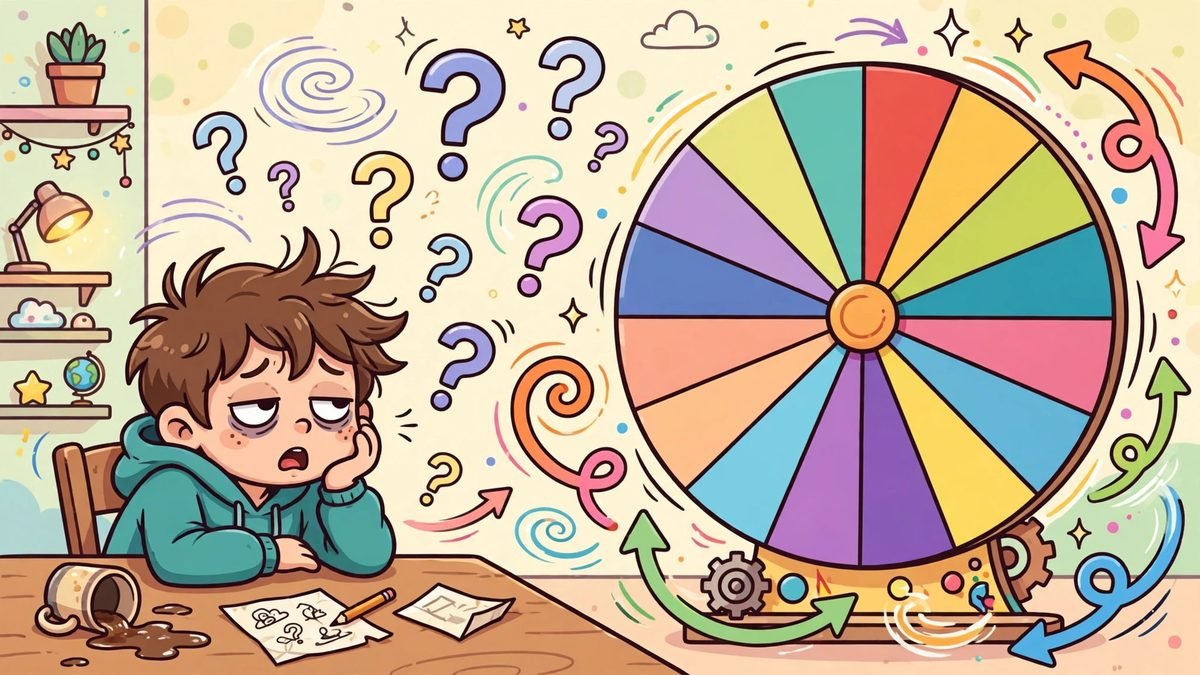
Decision Fatigue: How Randomizers Give Your Tired Brain a Break
By the time you sit down for dinner, you have already made hundreds of small decisions. What to wear. What to eat for breakfast. Which route to take. Which email to answer first. Whether to post that comment. What to buy while it is on sale. If picking a dinner spot feels oddly exhausting, you are not lazy and you are not indecisive. You are probably running into decision fatigue, the drained, foggy feeling that builds after a long stretch of choosing. The encouraging news is that you do not need more willpower to fix it. You need fewer decisions, and a simple randomizer can quietly take dozens of low-stakes ones off your plate.
This guide explains what decision fatigue is, why small choices tire us more than we expect, and how tools like our Yes or No Wheel or a quick spin of a random number generator can hand minor decisions to chance. The result is more mental energy left for the choices that genuinely matter.
Table of Contents
- What Is Decision Fatigue?
- Signs Your Brain Is Tired of Deciding
- Why Small Choices Are Surprisingly Draining
- How Randomizers Relieve Decision Fatigue
- When to Randomize and When to Think It Through
- Simple Routines That Cut Daily Choices
- Frequently Asked Questions
What Is Decision Fatigue?
Decision fatigue is the idea that after making many decisions, your ability to keep making good ones wears down. Psychologists describe it as a dip in the quality of decisions following a long session of deciding. Think of your focus like a battery: every choice, from the trivial to the serious, draws a little charge. By evening, the battery runs low, and that is when you either grab the easiest option without thinking or freeze up and decide nothing at all.
Neither reaction means you are weak. Both are your brain trying to conserve energy. The trouble is that the easy option is not always the right one. Late-night impulse shopping, saying yes to things you would refuse in the morning, or scrolling restaurant menus for half an hour because nothing sounds good are all classic signs of an exhausted decision-maker. Wikipedia’s overview of decision fatigue offers a helpful summary of how psychologists describe the concept.
Decision fatigue is a useful concept rather than a medical diagnosis, and rest, stress, hunger, and mood all shape our choices too. But almost everyone recognizes the everyday pattern: the more you decide, the harder deciding gets. That pattern is real enough to plan around.
Signs Your Brain Is Tired of Deciding
Decision fatigue rarely announces itself. Instead, it shows up as small behavioral shifts that are easy to blame on mood or personality. Watch for these patterns, especially in the late afternoon and evening:
- You default to the easiest option. Takeout instead of cooking, the first search result instead of comparing, or saying yes just to end the conversation.
- You avoid deciding entirely. You put off replying to a message, leave tabs open for days, or let someone else choose because picking feels like too much.
- Small choices feel oddly heavy. Choosing a movie or a snack suddenly requires heroic effort, even though the stakes are tiny.
- You get snappy when asked for input. “I don’t care, you decide” becomes your catchphrase, and it comes with an edge.
- You second-guess decisions you already made. A tired brain revisits settled choices because it never felt confident about them in the first place.
If several of these sound familiar, the problem is probably your schedule, not your character. A day packed with back-to-back choices leaves little fuel for the evening ones.
Why Small Choices Are Surprisingly Draining
It seems strange that choosing a sandwich could tire the same brain that handled a work presentation an hour earlier. The reason is that your brain does not neatly separate big decisions from small ones. Each choice, regardless of importance, requires attention, comparison, and a small prediction about the future. Dozens of tiny predictions add up.
Modern life multiplies those tiny predictions. Streaming services offer thousands of titles. Grocery stores stock dozens of nearly identical products. Phones buzz with options all day: reply now or later, accept the update, pick a filter, choose a playlist. None of these matter much on their own, but together they keep your mind in a constant state of evaluation. By the time a decision truly counts, your mental budget is already spent.
There is also a hidden cost to keeping options open. Every undecided item sits in the back of your mind, quietly consuming attention. Closing these open loops, even by letting chance decide, gives your brain permission to move on.
How Randomizers Relieve Decision Fatigue
Here is the simple insight behind this whole guide: not every decision deserves your full attention. Some choices genuinely do not matter much, and treating them as if they do is what wears you out. A randomizer is a tool for matching effort to importance. It lets chance handle the low-stakes calls so your brain can rest between the ones that count.
Think about all the tiny forks in an ordinary day. What to have for lunch. Which workout to do. Which of five errands to run first. What movie to watch on Friday. None of these will change your life, yet each one asks your brain to compare, predict, and commit. Handing them to a spinner or a number draw takes seconds and closes the loop instantly. The choice is made, it is fair, and you can move on without the nagging feeling that you picked wrong.
Randomizers also short-circuit a sneaky source of fatigue: the fear of regret. When you choose deliberately and the outcome disappoints, you blame yourself. When chance chooses, there is nothing to second-guess. That emotional relief is real, and it is one reason people find random tools oddly satisfying. A quick flip of the coin flip tool or a spin of the wheel turns “I need to decide” into “let’s see what happens,” which is a much lighter mental state.
You can also use randomness as a gut-check: spin the wheel, notice whether you feel relieved or disappointed by the result, and let that flash of feeling tell you what you wanted all along.
When to Randomize and When to Think It Through
Randomness is a wonderful servant but a poor master. The trick is knowing which decisions belong to chance and which deserve your full attention. A practical rule of thumb: if the options are roughly equal and the outcome is reversible, randomize freely. If the decision is hard to undo or the stakes are high, slow down and think.
Great candidates for randomizing include meal choices, entertainment picks, the order of chores, which route to take when both are fine, who goes first in a game, and light either-or questions you keep going back and forth on. These are decisions where “good enough, decided quickly” beats “perfect, decided after twenty minutes.”
Keep deliberate thinking for the big stuff: career moves, major purchases, health choices, relationships, and anything involving other people’s trust or safety. Randomizers are not a substitute for judgment where judgment is needed. They are a way to protect your judgment by spending it where it counts. If you ever catch yourself wanting to flip a coin over something important, treat that urge as a signal to pause and gather more information instead.
In the gray zone in the middle, use the random result as a starting point, then keep it or override it. Either way, you reach clarity faster than by circling the question for an hour.
Simple Routines That Cut Daily Choices
Beyond individual random draws, you can redesign parts of your day so fewer decisions arise in the first place. These small systems compound over time:
- Theme your days. Assign loose themes, like errands on Tuesday and creative work on Thursday. When a small task appears, its day is already decided.
- Build a shortlist. Instead of choosing dinner from every restaurant in town, keep a rotating list of five favorites, number them, and draw a number to pick. Fewer options means less deliberation.
- Automate the repeatables. Eat the same breakfast on weekdays, wear a simple rotation of outfits, and schedule recurring tasks at fixed times. Boring is the point.
- Batch small decisions. Once a week, spend ten minutes planning meals, workouts, and errands for the days ahead. Future you will thank present you.
- Set decision deadlines. Give trivial choices a two-minute limit. If you have not decided by then, let chance decide. A timer plus a randomizer ends deliberation spirals fast.
The common thread is that you decide once, up front, how small choices get made. After that, the system runs itself. Combined with a handy random tool for the leftovers, you can clear a surprising amount of mental clutter from an ordinary day. If you want to know more about the people behind these tools, visit our about page.
Frequently Asked Questions
What exactly is decision fatigue?
Decision fatigue is the worn-out feeling that builds after making many decisions, leading to poorer choices or avoidance of choosing altogether. It is a psychological concept, not a medical diagnosis. Most people notice it as relying on the easiest option late in the day.
Is decision fatigue a real thing?
The everyday pattern is widely recognized: the more you decide, the harder deciding gets. Researchers debate the exact mechanisms, but the practical advice stays the same either way. Reducing unnecessary choices and resting between important ones helps most people think more clearly.
How can a randomizer help with decision fatigue?
A randomizer takes low-stakes decisions off your mind instantly, closing mental loops that would otherwise linger. It removes the fear of picking wrong, since chance made the call. That frees your attention for decisions that genuinely deserve careful thought.
Should I use randomizers for important decisions?
No. Random tools are best for low-stakes, reversible choices where the options are roughly equal. Big decisions about health, money, career, or relationships deserve deliberate thought, research, and sometimes advice from people you trust. Use randomness to protect your judgment, not replace it.
What are some easy ways to reduce daily decisions?
Automate repeatables like breakfast and outfits, theme your days, batch small decisions weekly, and set two-minute deadlines for trivial choices. Keep a shortlist of favorites for meals and entertainment, and let a random draw pick from the list. Small systems like these compound into a noticeably lighter mental load.