Debate Topics for Clubs: A Random Picker That Keeps Meetings Fresh
Finding debate topics for clubs is harder than it looks. The same few members suggest topics, the same themes come up again and again, and half the club quietly zones out because they have argued about school uniforms three times already.
A debate-topic picker solves the “what do we argue about tonight?” problem in seconds. Load a wheel with motions, spin, and the club debates whatever chance delivers. The randomness keeps meetings surprising, spreads topic-choosing power fairly, and — best of all — forces members to argue sides they would never have picked themselves.
This guide shows how clubs use a topic picker, breaks down eight categories of great club debate topics with example motions, and shares tips for running a debate night everyone enjoys.
Table of Contents
- Why Clubs Need a Topic Picker
- How a Topic Wheel Works
- 8 Categories of Great Club Debate Topics
- Choosing Motions Everyone Enjoys
- Running a Debate Night
- Frequently Asked Questions
Why Clubs Need a Topic Picker
Most debate clubs run into the same three problems. First, topic selection becomes political — whoever shouts loudest or arrives earliest sets the agenda. Second, topics repeat because nobody tracks what has been debated. Third, members prepare only for topics they like, which means the same confident speakers dominate.
A random topic picker fixes all three at once. The wheel chooses, so nobody can complain the topic was rigged. You can remove each motion after it is used, which automatically prevents repeats. And because nobody knows the topic in advance, everyone has to think on their feet — which is the entire point of debating.
There is also a skill-building bonus. In formal debate, speakers often have to defend positions they personally disagree with. A topic wheel trains exactly that muscle: you might spin “pineapple belongs on pizza” as a deadly serious motion, and you will argue it like your reputation depends on it.
How a Topic Wheel Works
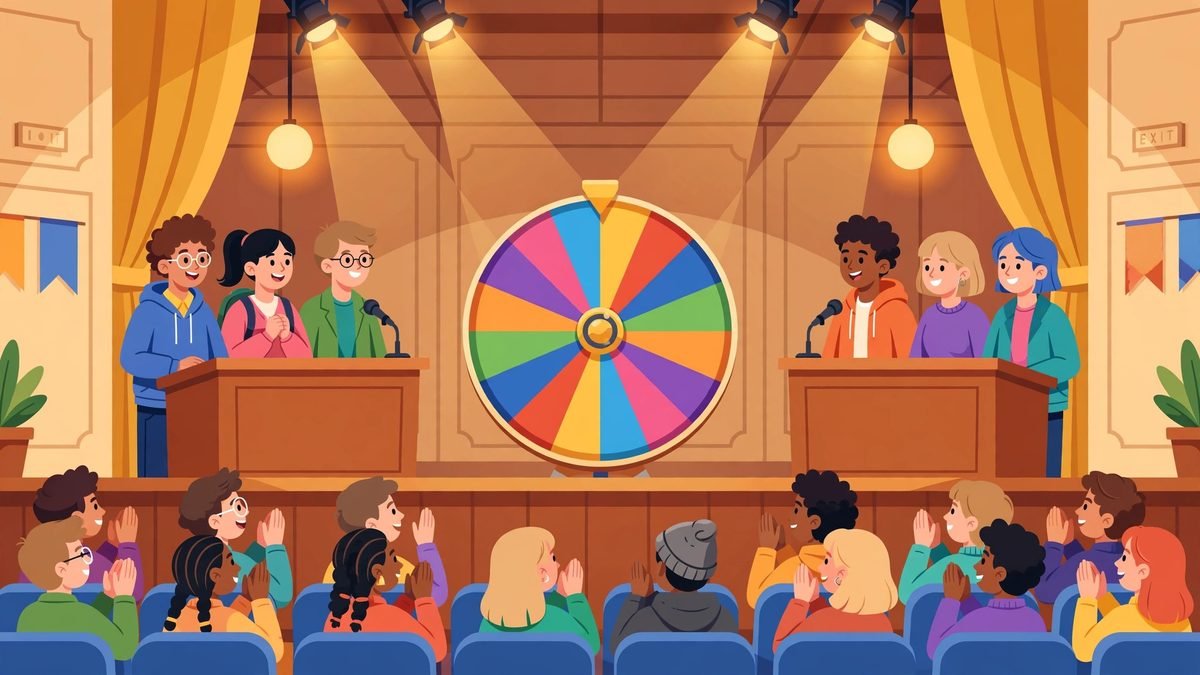
The concept is simple. Your club maintains a list of debate motions — statements like “Social media does more harm than good.” Before a meeting, you load a batch of motions onto a wheel. At the meeting, you spin, read the motion aloud, and the debate begins.
Most clubs spin twice: once for the motion and once for sides. After the topic lands, a second spin — or a quick coin flip — decides which team argues for the motion and which argues against it. This keeps things fair and stops the stronger team from always grabbing the easier side.
You can run the whole thing on the free Yes or No Wheel with a shared screen. Type in your motions, spin, and everyone watches the topic reveal together — it genuinely builds anticipation in the room.
8 Categories of Great Club Debate Topics
A healthy topic list draws from many categories. Here are eight to stock your wheel with, each with example motions to get you started.
1. Technology and AI
Tech motions are endlessly debatable because the ground shifts every year. Try these: “AI assistants should be allowed in classrooms,” “Social media platforms should verify every user’s identity,” or “Robots will create more jobs than they destroy.”
2. Environment and Nature
Environmental topics spark passionate arguments. Examples: “Cities should ban private cars from downtown areas,” “Zoos do more harm than good,” or “Individual actions matter more than government policy for the climate.”
3. Education and School
Students love debating the system they live in. Try: “Homework should be abolished,” “School should start later in the morning,” or “Grades do more harm than good.”
4. Society and Culture
These motions get personal in the best way. Examples: “Fame is more of a curse than a blessing,” “Traditions hold society back,” or “Everyone should learn a second language.”
5. Sports and Games
Perfect for lighter meetings. Try: “Video games should be considered a sport,” “Athletes are paid too much,” or “Chess is harder than football.” To pick which sport-themed motion comes up, you can even roll a dice roller against a numbered list.
6. Fun and Silly
Every club needs pure-fun motions for low-energy days. Examples: “Cereal is better dry than with milk,” “A hot dog is a sandwich,” or “Aliens would be disappointed by humanity.” Silly topics secretly build serious skills — arguing nonsense well is harder than it looks.
7. Ethics and Philosophy
For meetings when the club wants depth. Try: “It is wrong to keep secrets from friends,” “Happiness matters more than success,” or “People can truly change.” These motions have no right answer, which makes for the best debates.
8. Current Events
Topical motions keep the club connected to the world. The trick is phrasing them to stay evergreen: “Space exploration is worth the cost,” “Universal basic income would improve society,” or “News should always be free.” Refresh this category each term so it never goes stale.
Choosing Motions Everyone Enjoys
Not every topic deserves a place on the wheel. The best club motions share a few traits. They are balanced — a reasonable person could argue either side. They are accessible — every member knows enough to have an opinion without hours of research. And they are interesting — the room leans forward when the motion is read.
Let members submit motions. Keep a shared document or a suggestion box where anyone can add ideas, then curate the best ones onto the wheel. When members see their suggestion come up, their investment in the club jumps.
Retire motions after use, but keep a hall of fame. The debates everyone still talks about months later deserve to be remembered — and occasionally revisited with new members who were not there the first time.
Watch out for topics that consistently produce one-sided debates. If one side wins every time, the motion is probably unbalanced. Either rephrase it to sharpen the tension or drop it. A quick way to generate fresh, balanced ideas is to spin a random letter generator and challenge members to invent a motion starting with that letter.
Running a Debate Night
A smooth club debate night needs only a loose structure. Start with the topic spin — build a little ceremony around it, because the reveal is half the fun. Give teams five to ten minutes to prepare arguments; shorter prep keeps energy high and rewards quick thinking.
Run the debate in short rounds: opening statements, rebuttals, and a quick audience Q and A. Keep speeches tight — two minutes per speaker is plenty for a club setting. End with a vote: the audience picks the winning team, not by which side they agree with, but by who argued better.
Close the night by spinning for next week’s topic in advance if your club likes to prepare, or keep it a surprise if your club prefers spontaneity. Either way, the wheel has done the hardest job of the evening — choosing — before anyone could argue about it.
Frequently Asked Questions
How many topics should our club keep on the wheel?
Twenty to thirty active motions is a good working list — enough variety that repeats are rare, small enough to curate for quality. Keep a bigger backlog document and promote the best submissions onto the wheel each month.
What if the wheel picks a topic we just debated?
Remove each motion from the wheel right after it is used. That one habit eliminates the problem entirely. If your tool does not support removing entries, keep a “used” list and skip duplicates with a re-spin.
Should we assign sides randomly too?
Yes, whenever possible. Random sides are what make club debating a real skill-builder — members learn to argue positions they do not personally hold. A coin flip or a second wheel spin decides sides in seconds.
How do we handle sensitive topics?
Set ground rules once, up front: argue the position, never attack the person, and anyone can call a pause if a topic feels too raw. Give the club a veto — if a spun motion makes the room uncomfortable, spin again without debate about the skip.
Can beginners enjoy a topic-picker format?
Absolutely — it is actually ideal for beginners. Nobody has to prepare a speech in advance, the silly categories give newcomers low-pressure practice, and random sides mean a beginner never feels out-argued before they start.