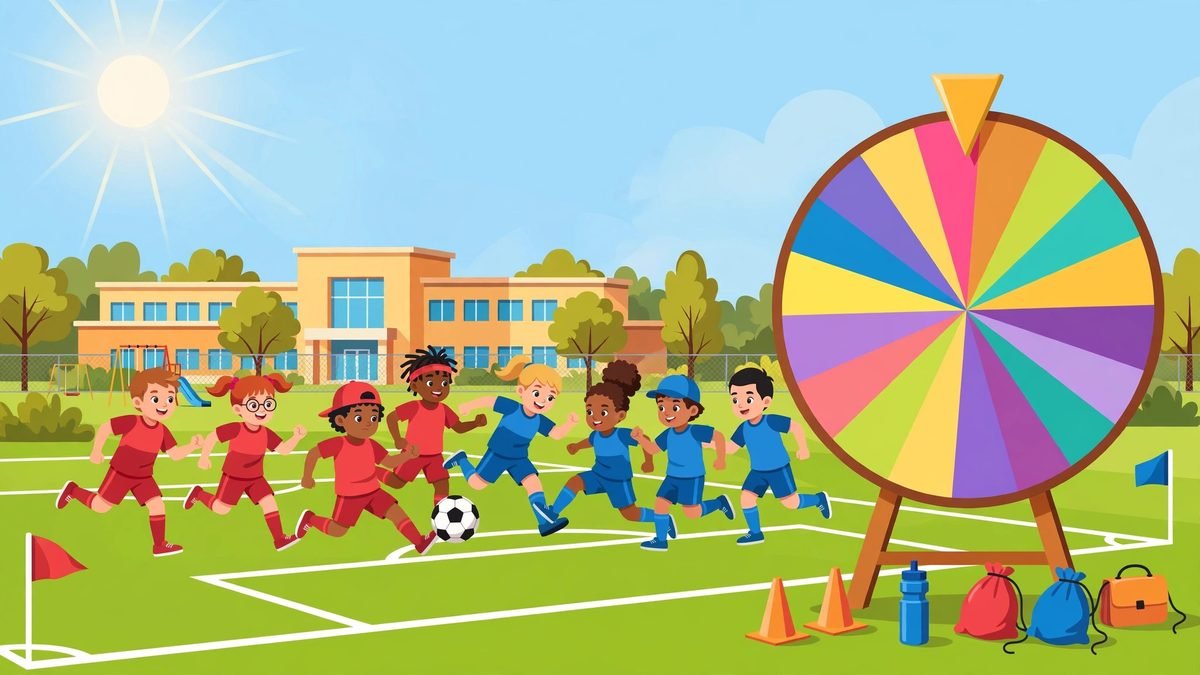
Random Team Generator: Fair Teams for Sports and PE Class
A random team generator solves one of the oldest problems in school sports: splitting a group into fair teams without hurt feelings. Instead of two captains picking players one by one — with the same kids always picked last — you let a tool do the dividing, fast and impartially.
Whether you teach PE, coach a youth league, or just organize weekend pickup games, random team generation saves time and spares everyone’s feelings. This guide explains how it works, the best methods for different situations, and how to keep teams balanced so games stay fun.
Table of Contents
- Why Team Selection Is Broken
- What Is a Random Team Generator?
- Methods for Splitting Teams
- Using a Random Team Generator in PE Class
- For Coaches and Rec Leagues
- Keeping Teams Balanced
- Frequently Asked Questions
Why Team Selection Is Broken
Everyone remembers the playground draft. Two captains, alternating picks, and a slow, public ranking of every kid’s athletic worth. The last few players stand there while everyone does the math on who is least bad. It is a ritual that teaches exactly the wrong lesson about sports.
Even well-meaning versions have problems. Counting off “one, two, one, two” is random-ish but predictable — students quickly figure out the pattern and swap numbers with friends. Having the teacher hand-pick teams invites accusations of favoritism, even when the teacher is trying to be fair.
A random team generator fixes all of this at once. The selection is visibly impartial, it takes seconds instead of minutes, and nobody can argue with the result. Students accept random outcomes far more readily than human decisions — the same psychology that makes a classroom name wheel work for physical education participation.
What Is a Random Team Generator?
A random team generator is any tool or method that divides a list of names into teams by chance. The simplest digital version is a name wheel: enter all the players, then spin and alternate assignments — first spin goes to Team A, second to Team B, and so on. After one pass through the list, you have two evenly sized, randomly composed teams.
Some tools do this automatically, shuffling the whole list and dealing it out like cards. Others give you more control, letting you set the number of teams, team sizes, and whether certain players must be separated. The underlying principle is always the same: chance decides, not people.
You can run a quick team split with the free Yes or No Wheel — enter the names, spin alternately for each team, and you are done in under a minute.
Methods for Splitting Teams
Different situations call for different approaches. Here are the most practical methods, from simplest to most controlled.
Alternate draft from a shuffled list
Shuffle the full list of names, then deal them out: first name to Team A, second to Team B, third to Team A, and so on. This is the fastest method and guarantees even team sizes when the player count divides evenly.
Wheel spins for each player
Put all names on a wheel, spin, and assign the winner to the next team in rotation. This is the most transparent method — everyone watches each pick happen. It takes a little longer with big groups, but the theater of it makes students trust the result.
Number draw for stations or groups
When you need more than two teams — say, four groups for circuit training — assign each student a number with a random number generator, then group by number range. It is quick, scalable, and easy to explain.
Coin flip for captains and sides
For the small decisions around the main split — who picks the field side, who serves first, which team wears the bibs — a quick coin flip settles it instantly. Keep the coin handy; you will use it more than you expect.
Using a Random Team Generator in PE Class
PE teachers have the toughest version of this problem: a new class every period, mixed abilities, limited time, and students who remember exactly who picked them last. Random generation earns its keep here every single day.
Build a saved list for each class period so you are not typing names during precious gym time. When the lesson starts, generate teams while students warm up — by the time they are done stretching, the teams are on the board.
Vary the method across the week so it stays fresh: alternate draft on Monday, wheel spins on Wednesday, number groups on Friday. Students stop gaming the system when the system keeps changing, and the variety itself becomes part of the fun.
For skill-heavy units like basketball or soccer, consider a two-stage split: randomly assign a few stronger players as “seeds,” one per team, then randomly fill the rest. The teams are still mostly random, but you avoid the occasional nightmare matchup of all the experienced players on one side.
For Coaches and Rec Leagues
Coaches use random team generators differently from teachers. In a youth league draft, randomness is the foundation of fairness — parents trust a lottery far more than a coach’s judgment. Many rec leagues literally draw names from a hat; a digital wheel is the same idea, visible to the whole room on a projector.
For practice scrimmages, random teams are a coaching tool. Players who always train together develop habits and blind spots. Shuffling the squads every practice forces everyone to adapt, communicate with new teammates, and play different roles. It also stops practice from feeling stale.
Adult pickup games benefit too. Nothing kills a casual game night faster than a twenty-minute argument about teams. Agree on one rule — the wheel decides — and you are playing within a minute. For a final coin-flip-level decision like which end to defend, the dice roller works just as well when you want a number instead of heads or tails.
Keeping Teams Balanced
Pure randomness occasionally produces lopsided teams — that is the nature of chance. The goal is not perfect parity every time, but a system everyone trusts. A few habits keep things fair over the long run.
First, re-randomize regularly. One unlucky split matters little when teams are redrawn every class or every practice. Students accept a tough draw when they know a fresh one is coming tomorrow.
Second, separate only when safety or sense demands it. In contact sports or big age gaps, it is reasonable to split by size or experience band first, then randomize within each band. That is still far fairer than a captain’s draft.
Third, watch for patterns, not single events. If random splits keep producing the same imbalance, adjust the method — add seeding, change team sizes, or split the pool differently. Fairness is a system you tune, not a single perfect draw.
Frequently Asked Questions
Is a random team generator really fair?
Yes — that is the whole point. Every player has an equal chance of landing on any team, and because the process is visible, everyone can see that no human bias was involved. Randomness is the fairest team picker there is.
What if random teams end up uneven?
It happens occasionally, and the fix is simple: redraw. Because generating teams takes seconds, you can spin again whenever a split looks badly lopsided. Over many redraws, everyone gets a fair mix of teammates.
How do I handle an odd number of players?
A few options: rotate one player as a substitute each round, let the odd player join the smaller team as a “floater” who plays for whoever has the ball, or give one team a rotating extra player. Announce the rule before you spin.
Can I keep certain players on the same team?
Sometimes — for example, siblings who arrived together. The cleanest approach is to treat them as a single entry during the draw, then expand them onto the same team afterward. Use this sparingly so the randomness stays credible.
Should students see the draw happen?
Whenever possible, yes. Watching the wheel spin or the list shuffle is what builds trust in the result. A hidden draw invites suspicion; a visible one invites acceptance — and usually a few cheers.